Northstar decides
Goals, decomposition, specialist coordination, budgets, provenance, and final cognitive judgment.
Northstar is the executive cognitive layer inside Mainely Code Providence Architecture. It plans, routes, coordinates specialist contributors, manages budgets and provenance, preserves uncertainty, and owns final cognitive judgment.
Provider gives it power. Northstar gives it direction. Providence keeps it governed.
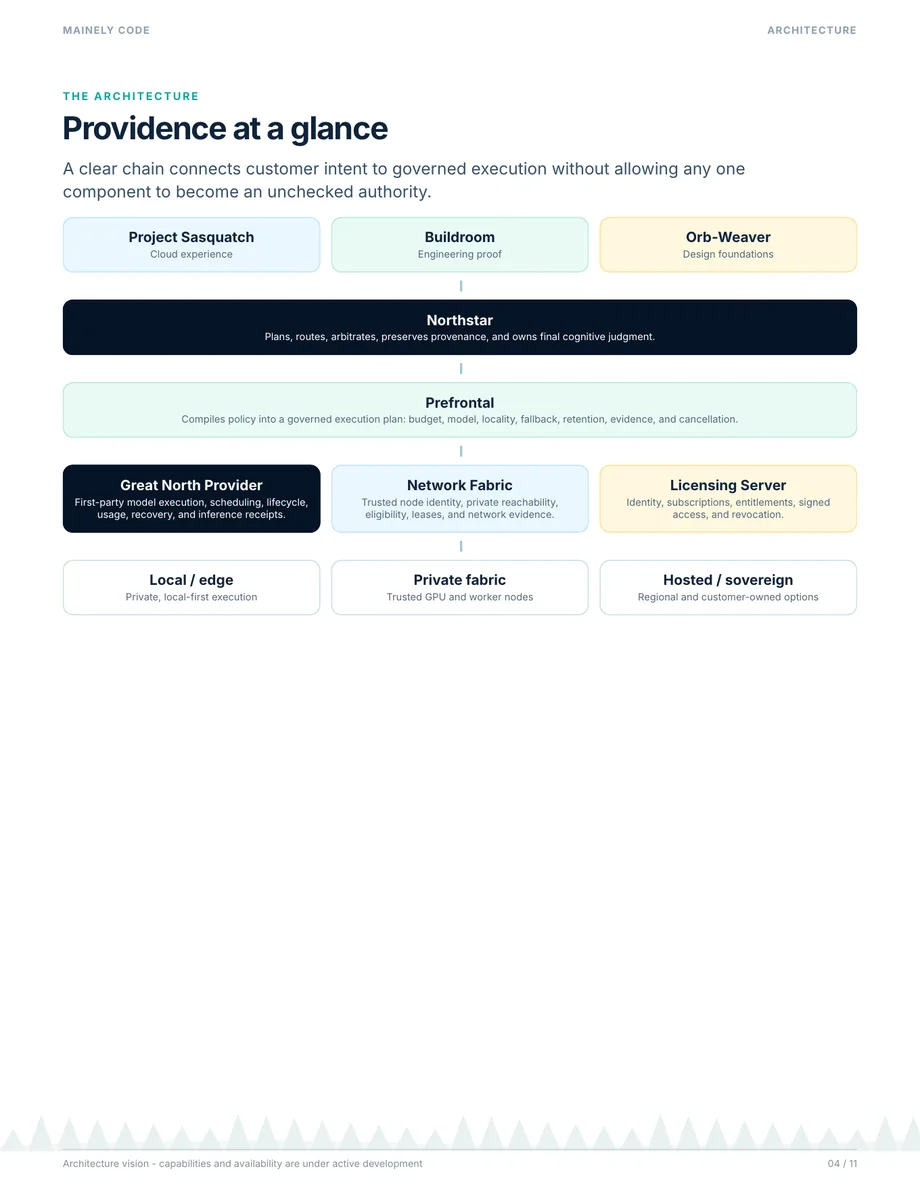
Mainely Code Providence Architecture
The Great North is the complete Mainely Code ecosystem. Providence is the governed architecture connecting cognition, policy, first-party inference, trusted compute, identity, products, and proof.
Goals, decomposition, specialist coordination, budgets, provenance, and final cognitive judgment.
Policy, locality, fallback, tools, retention, evidence, cancellation, and risk constraints.
Exact model release, scheduling, runtime lifecycle, streaming, usage, recovery, and inference receipts.
Node identity, private reachability, eligibility, leases, effective state, and infrastructure evidence.
Sasquatch owns the cloud journey. Buildroom verifies engineering. Orb-Weaver validates design output.
No component gets to grade its own homework. Provider cannot weaken policy, invent trust, grant access, or declare a product outcome successful.
The system is the spectacle
This is a deterministic, local architectural simulation—no live inference, external action, or hidden network request is being performed.
Raise assurance and watch external paths close, proof requirements multiply, simulation appear, and rollback become mandatory.
Research retained · Assumption B rejected · External action removed · Evidence requirement satisfied
Rejected. Policy requires simulation-first execution.
The Northstar thesis
Most AI products ask one model to act like an entire organization. Northstar takes a different path.
Complex work rarely belongs to one specialty. Research, memory, critique, planning, policy, multimodal analysis, design, engineering, and tool execution require different strengths.
Northstar coordinates those strengths under one executive plan—without hiding the route behind a vague story that “the models figured it out.”
A single contributor carries the entire burden of context, reasoning style, verification, cost, policy, and execution.
Contributors are selected for the lane, challenged where needed, governed by policy, and synthesized into one coherent result.
What is the right cognitive plan, route, and execution path for this goal?
Our primary focus
Models, tools, machines, memories, and execution systems contribute as specialists—not as an undifferentiated crowd.
Local systems, LAN workers, cloud models, and authorized external platforms can contribute without surrendering final routing logic, policy, or the evidence trail.
Each specialist is selected for capability, context, cost, latency, availability, policy, and constraints—not because one model happens to be open.
Northstar decomposes, routes, challenges, arbitrates, synthesizes, and checks the work instead of returning a pile of disconnected model outputs.
Executive coordination
Northstar may coordinate many reasoning regions and model types, but it is not a democracy. The executive core owns the plan, route, constraints, arbitration, and final synthesis.
Northstar coordinates. The regions contribute. The executive core decides.
Governance is part of the intelligence
Serious operators should be able to see what contributed, why it was selected, which constraints applied, where disagreement appeared, and what evidence supports the result.
Capture objective, context, permissions, deadlines, tools, budgets, acceptance criteria, and evidence requirements as explicit inputs to the plan.
Map dependencies, contributors, stop conditions, acceptance criteria, review points, and the evidence each lane must return.
Choose models, systems, memories, tools, or product-family execution arms according to capability, context, cost, latency, policy, and availability.
Compare findings, expose conflicts, engage critic and policy lanes, record the executive decision, and preserve the reasoning path for operator review.
Bind provenance, contributor records, policy decisions, confidence, limitations, and the proof level actually achieved—without promoting simulation into production truth.
Evidence before adjectives
The label on an output should reflect the strongest evidence actually captured. Northstar's proof posture is designed to make that boundary visible.
Expose the plan, participating regions, route decisions, disagreement, and final arbitration.
Preserve the origin of evidence, memory, model contributions, tool outputs, and execution artifacts.
Apply permissions, risk rules, data boundaries, cost limits, model constraints, and approvals.
Separate a persuasive answer from a supported result and attach the proof appropriate to the claim.
Test plans safely, use canaries and stop conditions, and keep simulated evidence honestly labeled.
Carry compensating actions, snapshots, verification, and safe next steps into bounded execution paths.
Designed for serious institutional work
Northstar's first market posture is B2B, education, government, and public-sector use cases where policy, provenance, budgets, operator control, and inspectability are requirements—not optional features.
Coordinate complex work across teams, models, policies, budgets, and execution systems without losing operator control.
Preserve source lineage, expose reasoning routes, and bring specialist perspectives together under transparent review.
Make policy, permissions, evidence, review, and accountability visible where consequential decisions demand a durable record.
The Great North
Northstar coordinates the product family through Providence without collapsing every product into one app or blurring responsibility.
The flagship cognitive platform that plans, routes, arbitrates, preserves provenance, and owns final cognitive judgment inside Providence.
The cloud-based experience through which Northstar capability can be presented to operators and users.
Open Project SasquatchThe proof-driven software engineer: bounded changes, tests, proof bundles, rollback, and verified pull requests.
Explore BuildroomThe local-first design and UI/UX loom: turning rough direction into clean, editable interface foundations.
Explore Orb-WeaverThe secure network authority for discovery, registration, policy, execution, evidence, verification, rollback, and effective-state determination.
See the authority modelThe Great North is the ecosystem. Providence is how it works. Northstar directs; the product and platform authorities retain their own jobs.
Release integrity
Northstar 1.0.2 is a locally verified architecture release for its exercised Windows, contract, mock, and declarative-plan scope. Live external systems remain named gates until independently exercised.
Locally verified release evidence · Northstar 1.0.2
The locally exercised release boundary is published plainly. Live Provider, cloud, worker-fabric, account-vault, and external integration paths remain active development gates.
The Great North public architecture brief
Read the public 11-page vision brief for the ecosystem, authority model, Great North Provider, dogfooding loop, deployment choices, and honest release posture.
The Great North by Mainely Code
Governed cognition for serious work—with route, identity, evidence, cost, authority, and operator control visible from the beginning.